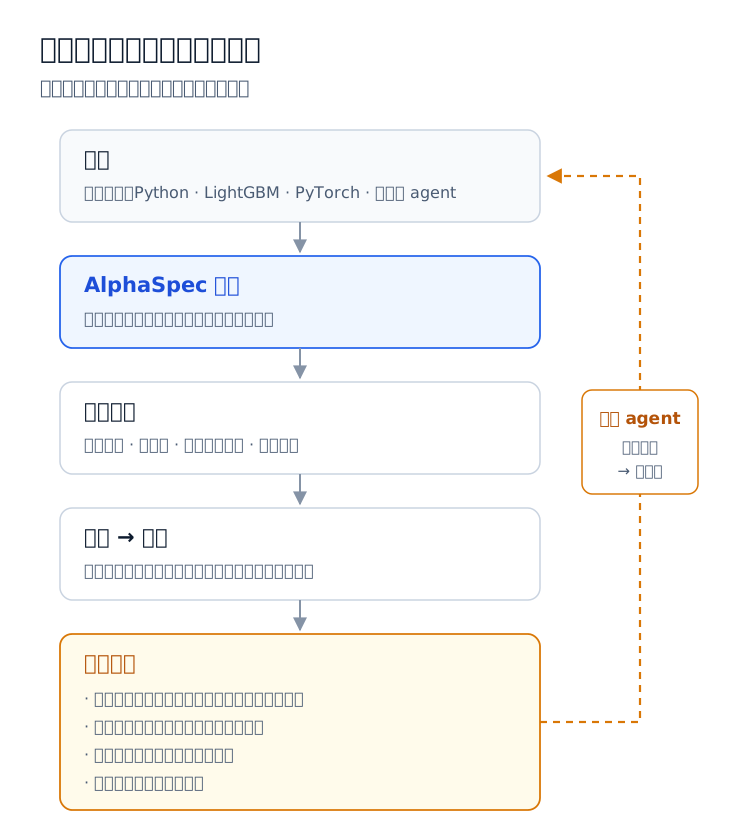
Models, factors and LLM agents propose ideas. Everything between a signal and a real fill — sizing, rebalancing, risk, execution, the ledger and reconciliation — is handled by one system. Keep your research stack and hand over the results.
The console, diagrams, screenshots and video currently use the Chinese interface. Blog articles and case studies are available in Chinese.
{
"contractVersion": "0.4",
"kind": "artifact",
"market": "cn_stock",
"timeframe": "1d",
"dsl": {
"indicators": {
"fast": { "type": "EMA", "period": 20 },
"slow": { "type": "EMA", "period": 60 }
},
"entry": {
"type": "CROSS_UP",
"left": { "ind": "fast" },
"right": { "ind": "slow" }
}
},
"exits": { "stopLossPct": 8 },
"sizing": { "positionMode": "FIXED_PCT",
"targetPctPerOrder": 20 },
"producer": { "kind": "AI_AGENT",
"searchTrials": 12 }
}
A strategy is not a piece of code but a declarative JSON document: which indicators, which entry and exit conditions, how stops and position sizes are set, and which market it trades. The specification, validator, indicator catalog and examples are open source under Apache-2.0.
The DSL is not our strategy language; it is the audit boundary between AI and live trading.
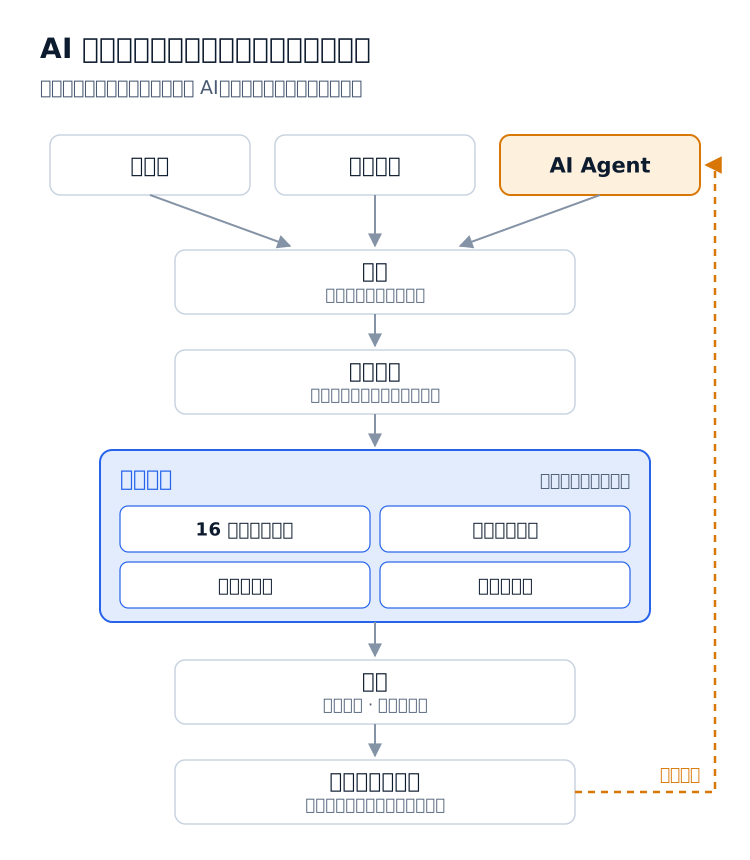
View AlphaSpec on GitHub →AI can produce hundreds or thousands of candidates in one go, and search alone produces good-looking backtests. So the gate never accepts the submitter's own numbers; the platform recomputes everything on the same definitions.
The pass rate may be low, and that is exactly why it can be trusted. Institutions can send their own alpha through the same gate as an independent review before going live.
The real weakness of AI research is not the model but the missing loop: a model never learns what happened to its signals in the real market. The platform turns the execution evidence of every run into data research can read directly.
A diagnosis agent reads this evidence and answers why a strategy stopped working, then hands it to a researcher or a generation agent for the next version.
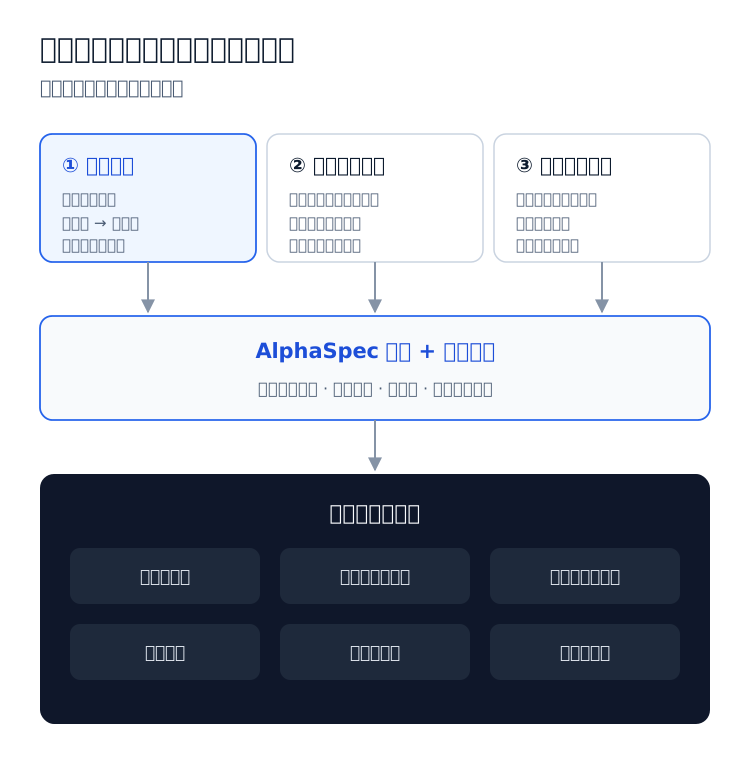
Institutional teams have their own Python, LightGBM, PyTorch and feature libraries. They do not need to move, and they should not. Integration happens only at the output of research, in one of three ways.
Sizing, rebalancing, risk, execution, the ledger and reconciliation take months to build in-house — and are exactly what research teams least want to build. Once connected, this part shares the same capabilities as every strategy on the platform.
The platform is not tied to a particular agent. Our own AI research is only a reference implementation: teams can use it directly or connect the tools they already trust.
Our own agents use only the public interfaces, with no internal shortcuts. Agents and people pass through the same gate — that is both the security design and the source of trust.
pip install alphaspec # Install the Agent Skills (write + diagnose) alphaspec skill --install ~/.claude/skills # Validate offline, then submit for evaluation alphaspec validate strategy.json alphaspec submit strategy.json --evaluate # After it runs, see what actually happened alphaspec evidence --artifact 42
Permissions are layered by risk: the closer to real money, the more a gate and a human are required.
| Capability | agent | Notes |
|---|---|---|
| Read market data, factors and the indicator catalog | Open | The same data permissions as a signed-in user |
| Submit strategy documents and upload daily scores | Open | Validated against JSON Schema and rules before submission; invalid documents are rejected on the spot |
| Backtest and gate evaluation | Recomputed by the platform | Windows are set by the platform, self-reported numbers are not accepted, daily quota applies |
| Read execution evidence | Open | On-time runs, rejection reasons with advice, target deviation, slippage, fill-by-fill ledger |
| Promote to a paper strategy | Gate required | Only strategies that passed the platform evaluation can be promoted, and they start disabled |
| Start or stop strategies | Not open | Confirmed by a person in the console |
| Place orders directly or change account-level risk settings | Never open | Orders come only from running strategies and pass the same pre-trade risk checks; a strategy's own risk limits live in its document and go through the gate with it |
We provide an integration plan, demo accounts and private deployment based on your team's research stack, strategy types and risk requirements.