System Overview

The full quantitative investment lifecycle
in one system

Data, research, strategies, backtesting, risk, execution, accounting and performance: each stage uses the actual results of the previous one. Backtesting, paper trading and live trading share the same logic, with reproducible and traceable results.

The console, diagrams, screenshots and video currently use the Chinese interface. Blog articles and case studies are available in Chinese.

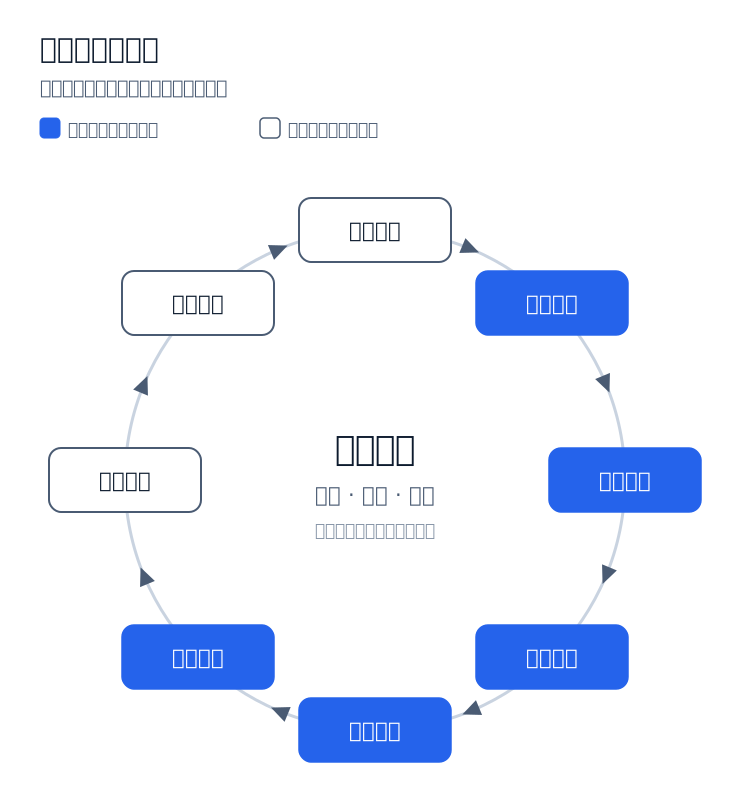
Data Research Strategies Backtesting Risk Execution Accounting Performance
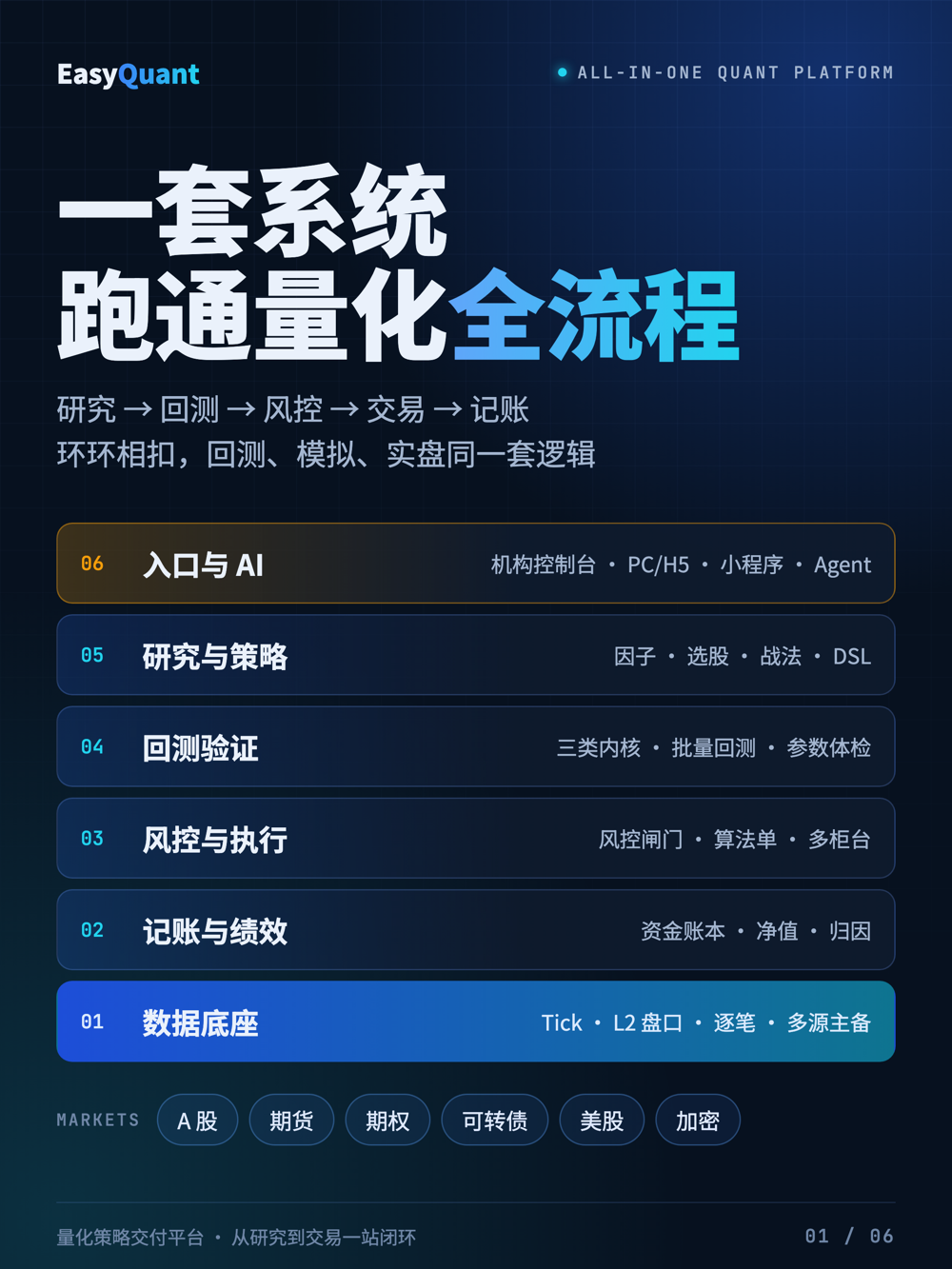
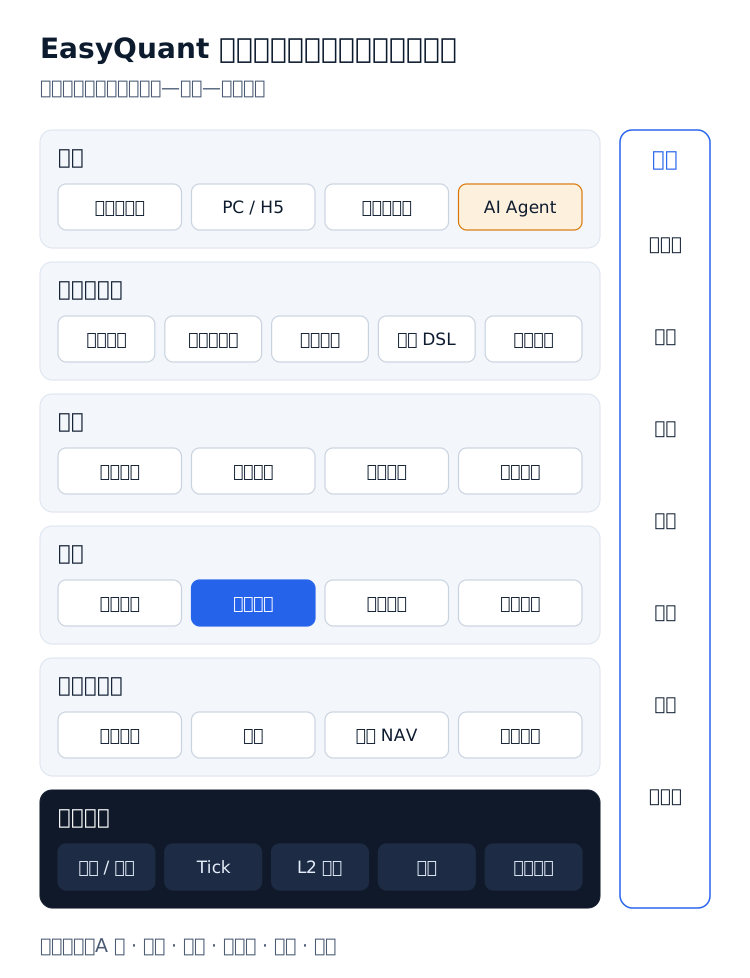
EasyQuant architecture: data, accounting and performance, risk and execution, validation, research and strategies, interfaces and AI; covering China A-shares, futures, options, convertible bonds, US equities and crypto
What it is

Quantitative strategy delivery platform

Move from strategies that individuals can run to assets teams can deliver and institutions can trust. Research tools and trading terminals leave a gap between them. EasyQuant provides that delivery layer.

  • Not a strategy marketplace: no signal sales or discretionary asset management.
  • Infrastructure: strategies can come from any source; the system handles the subsequent lifecycle.
  • Supports private deployment, keeping code, data and broker credentials on the client side.
Explore industry challenges and our response →
Explainable Structured reason codes explain missing signals or orders, without guessing from logs.
Reproducible Each backtest captures its inputs, helping locate differences between results.
Operable Monitoring, alerts, reconciliation and resolution use consistent evidence and definitions.
Extensible Add tenants, markets and broker gateways without changing the core.
= Trustworthy Shared logic across backtesting, paper trading and live trading, ready for scrutiny.
Architecture

One system, from data to performance

Six layers share one data model: market and time-series data underpin research, validation, trading and accounting, with governance across every layer.

  • Data foundation: daily and minute bars, native ticks, L2 order books, orders and trades, with automatic failover between data sources.
  • Research and strategies: factor research, multi-factor screening, chart patterns, strategy DSL and microstructure features.
  • Validation: equity portfolio, derivatives portfolio and single-instrument backtest engines, batch runs and parameter diagnostics.
  • Trading: portfolio rebalancing, risk gates, algorithmic execution and broker gateways.
  • Accounting and performance: cash ledger, positions, NAV, performance and attribution based on capital employed.
  • Governance: tenants, permissions, audits, strategy versions, monitoring and alerts.
EasyQuant layers: interfaces, research and strategies, validation, trading, accounting and performance, and data; governance spans all layers
Six layers share one data model, with governance throughout.
End to end

The complete journey of a signal

Signals are the easiest stage to build and demonstrate. Results depend on every stage that follows, where errors can often remain silent.

  • Factors, chart patterns or DSL rules generate a signal
  • It enters portfolio construction: target weights, rebalance sequencing and capital budgets.
  • It passes the risk gate: universe, order size, concentration, capital, margin, volatility and circuit breakers.
  • It is routed to paper or live trading gateways, with algorithmic order splitting where needed.
  • Fills, partial fills, rejections and cancellations are reported individually, with idempotent ledger updates.
  • Performance and attribution use capital employed; the next cycle reads actual positions.
Eight stages: market data, factor research, signals, portfolio construction, risk, execution, trade accounting and performance attribution
Deviations at any stage are visible to the next, with corresponding records and alerts.
One engine

One logic for backtesting, paper trading and live trading

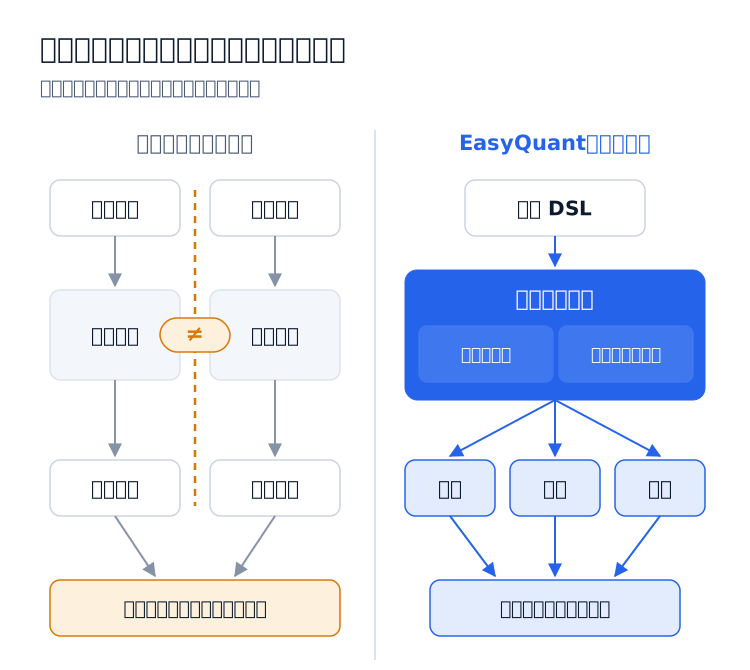
Many teams backtest with research scripts and deploy separate production code. Every difference can create unexplained divergence between backtests and live results.

  • One signal engine: DSL strategies are compiled and executed by the same engine.
  • Market rules defined in one place: T+1, margin, opening and closing positions, premiums, contract multipliers, sessions and price limits reside in the market behavior layer.
  • Live data and replay use the same pipeline: replayed order-book and tick features match their real-time calculations.
  • Performance uses executable assumptions: paper results, execution and performance ledgers consistently use next-day open execution.
EasyQuant uses one signal engine across backtesting, paper and live trading, with consistent performance definitions
Inconsistent definitions are a common cause of divergence between backtests and live results.
Live system

See the running system

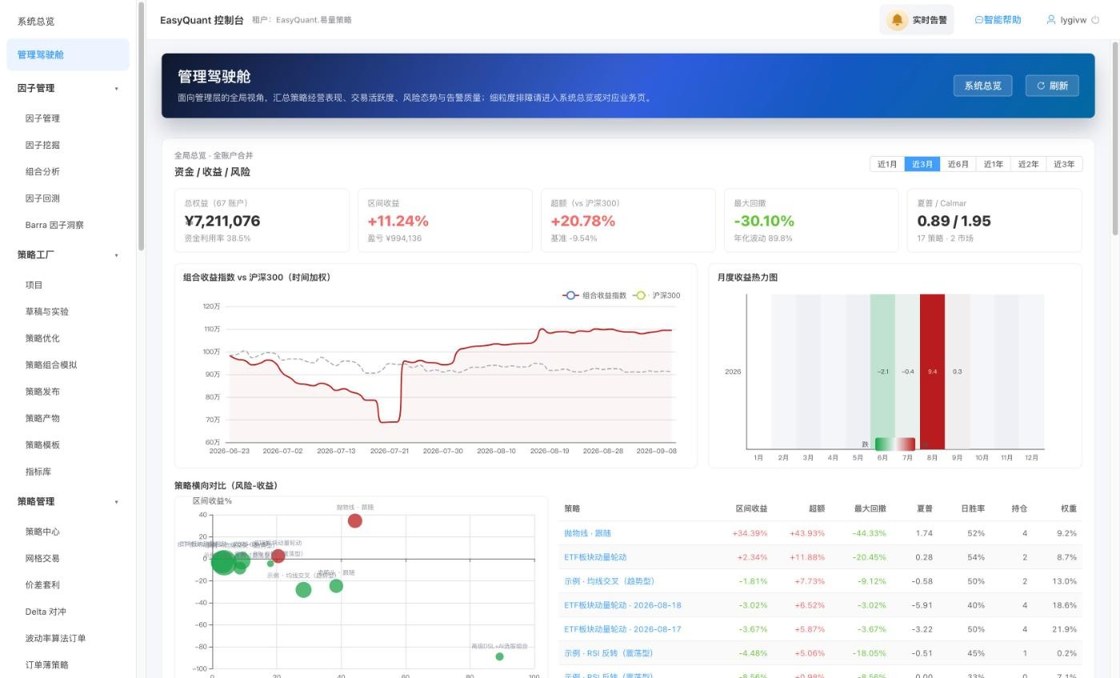
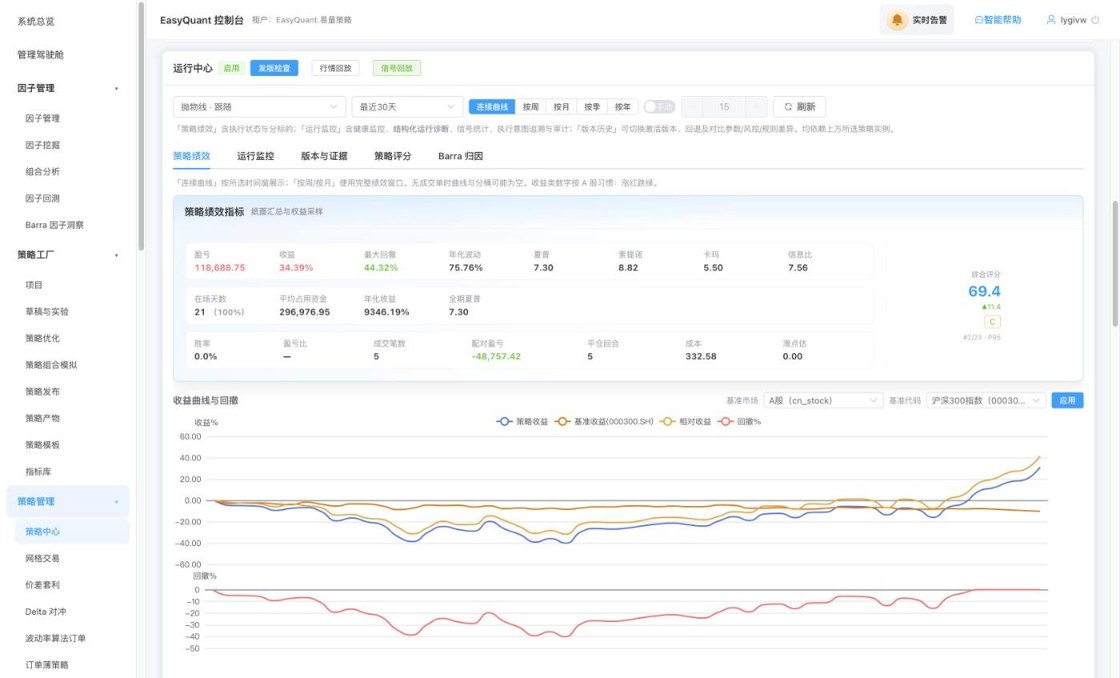
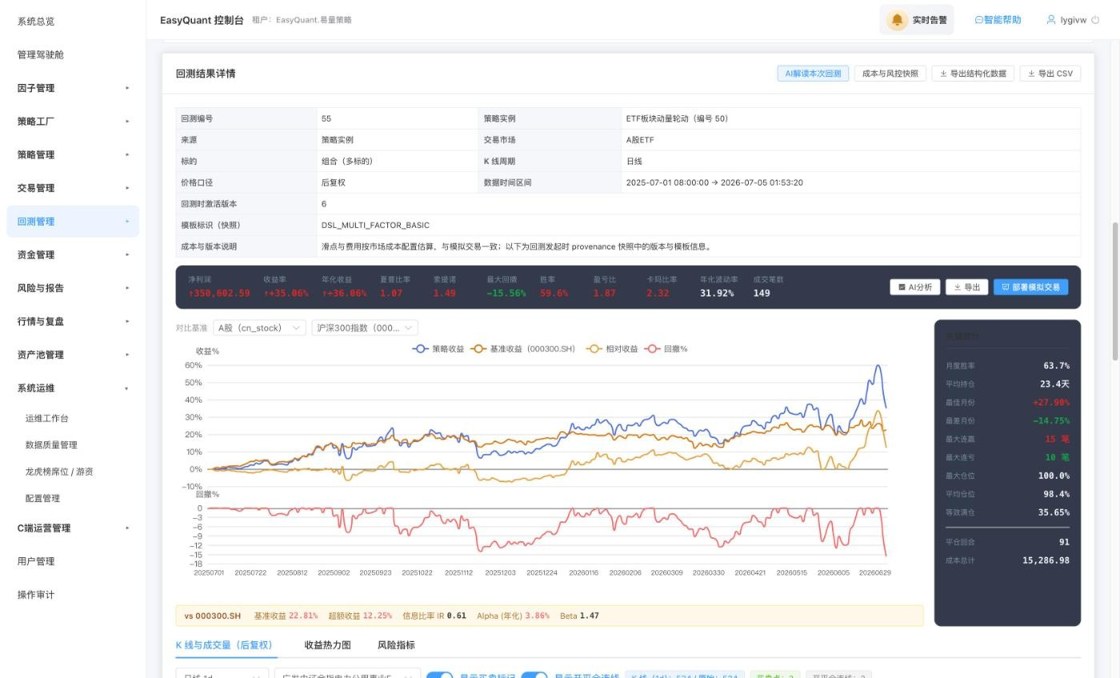
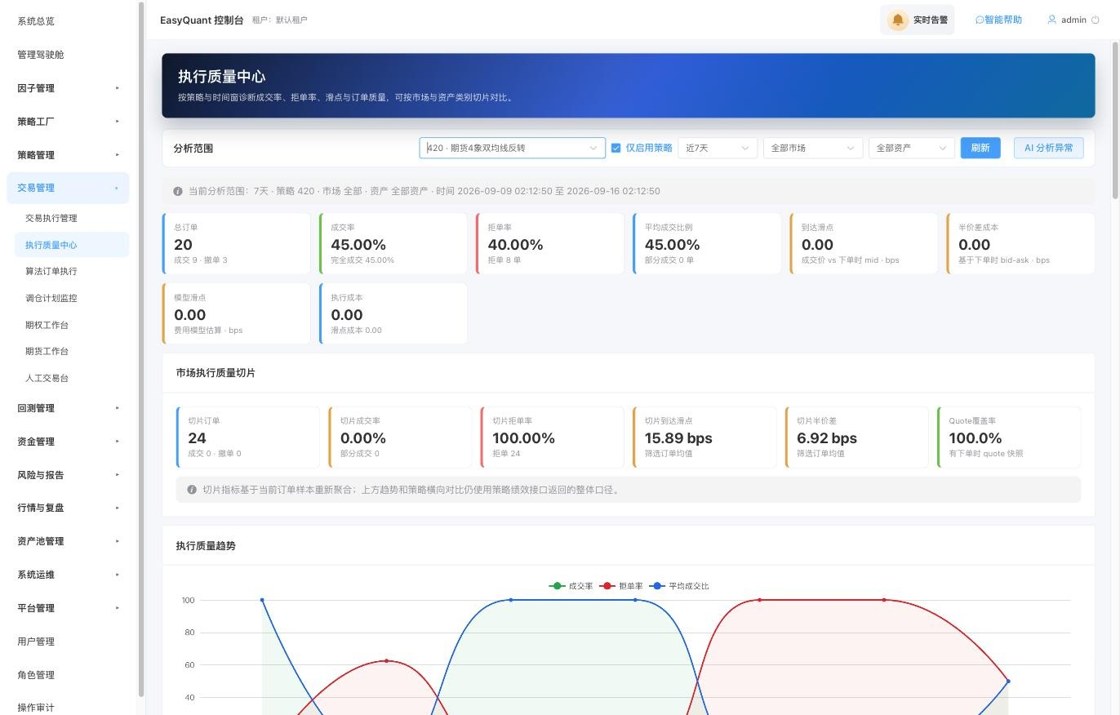
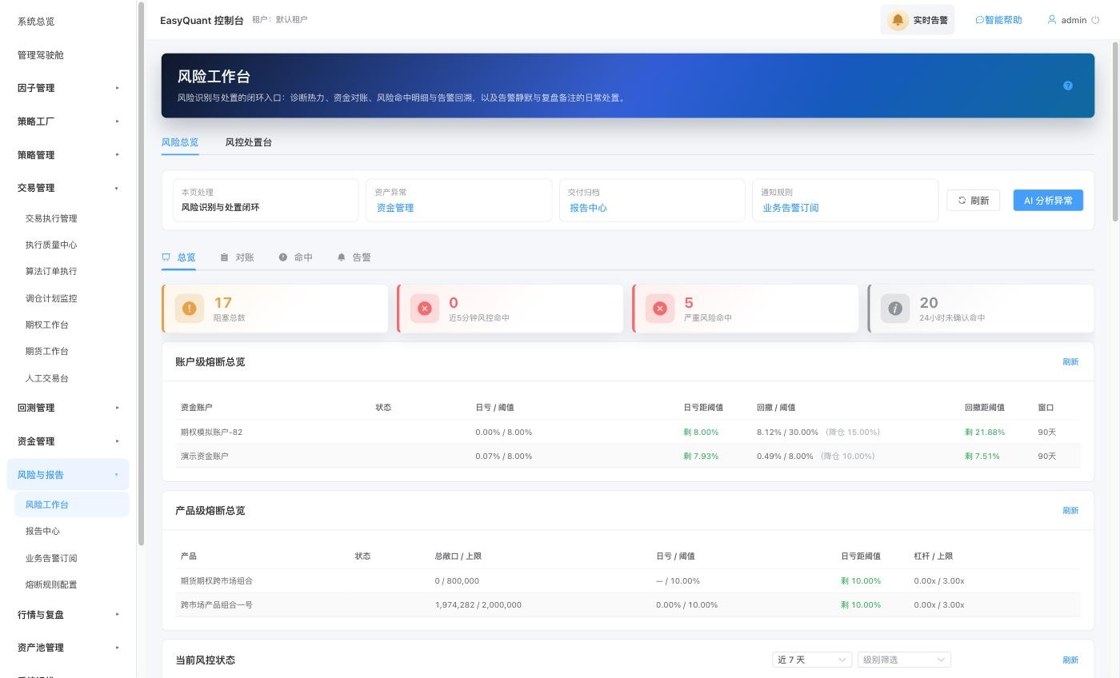
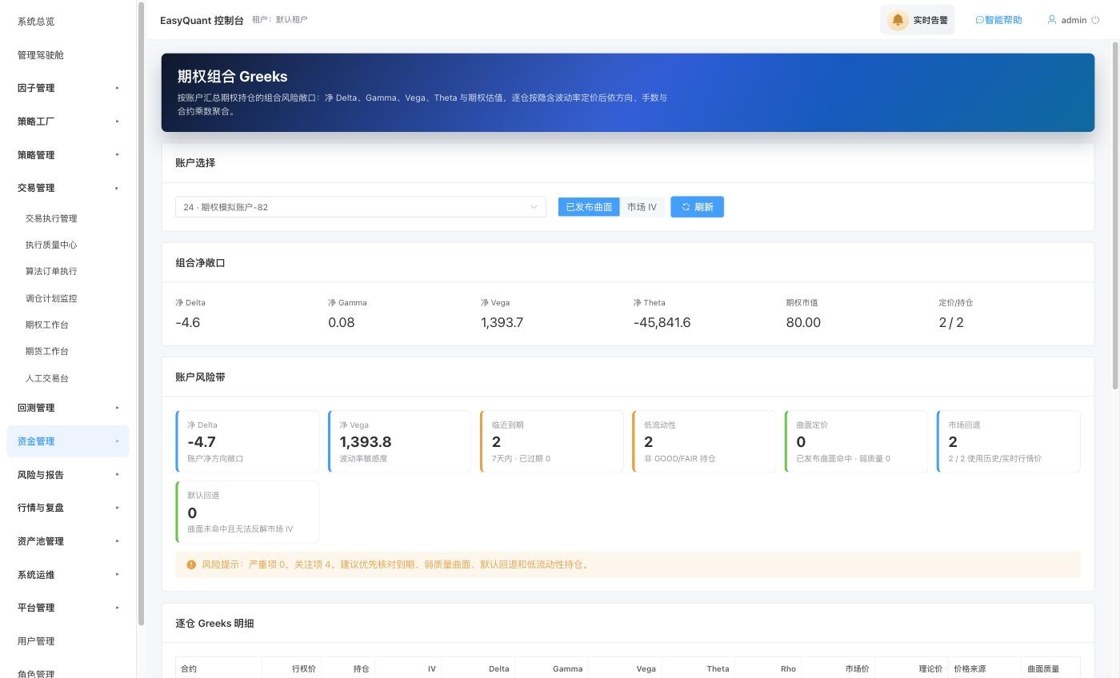
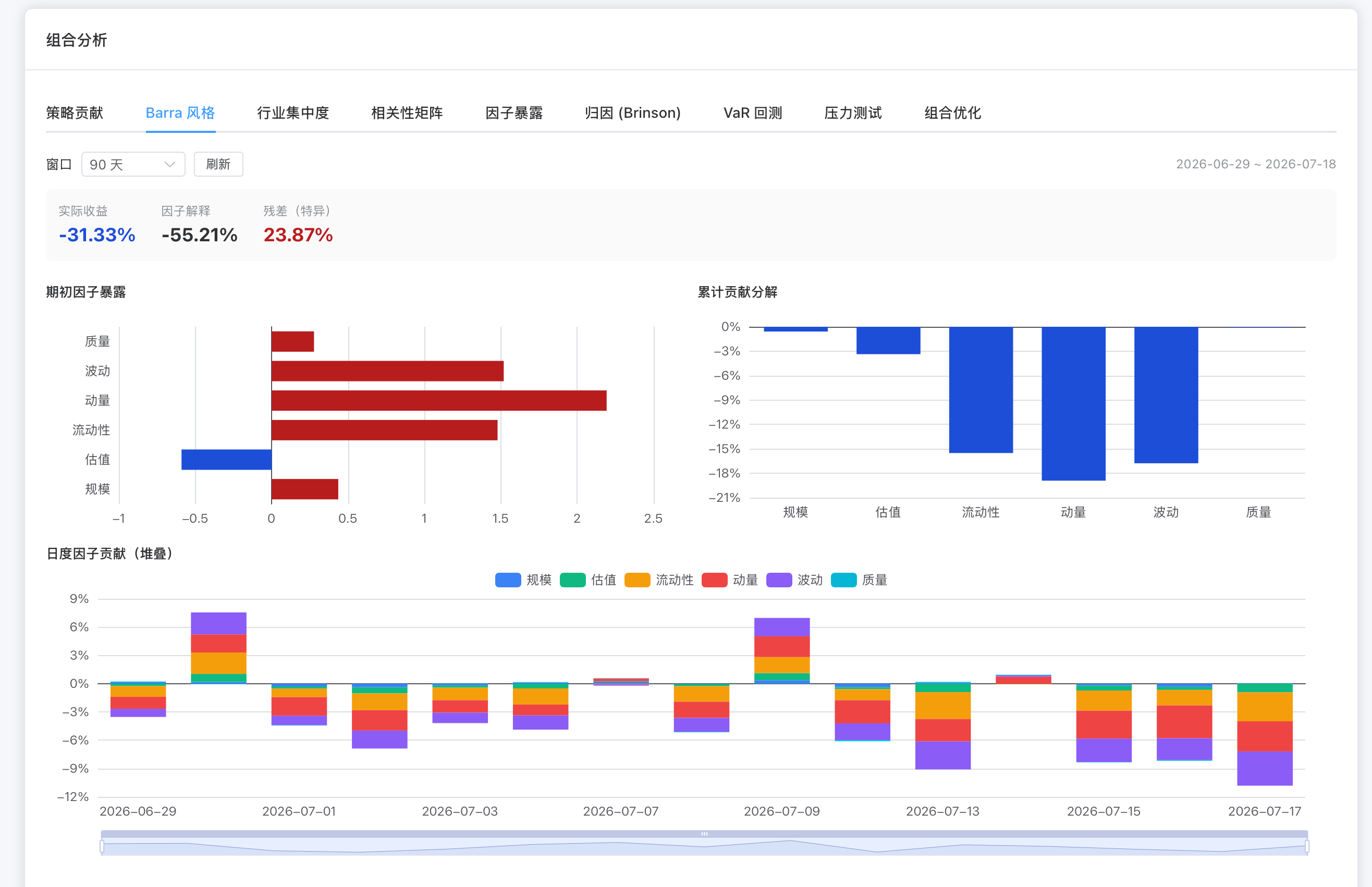
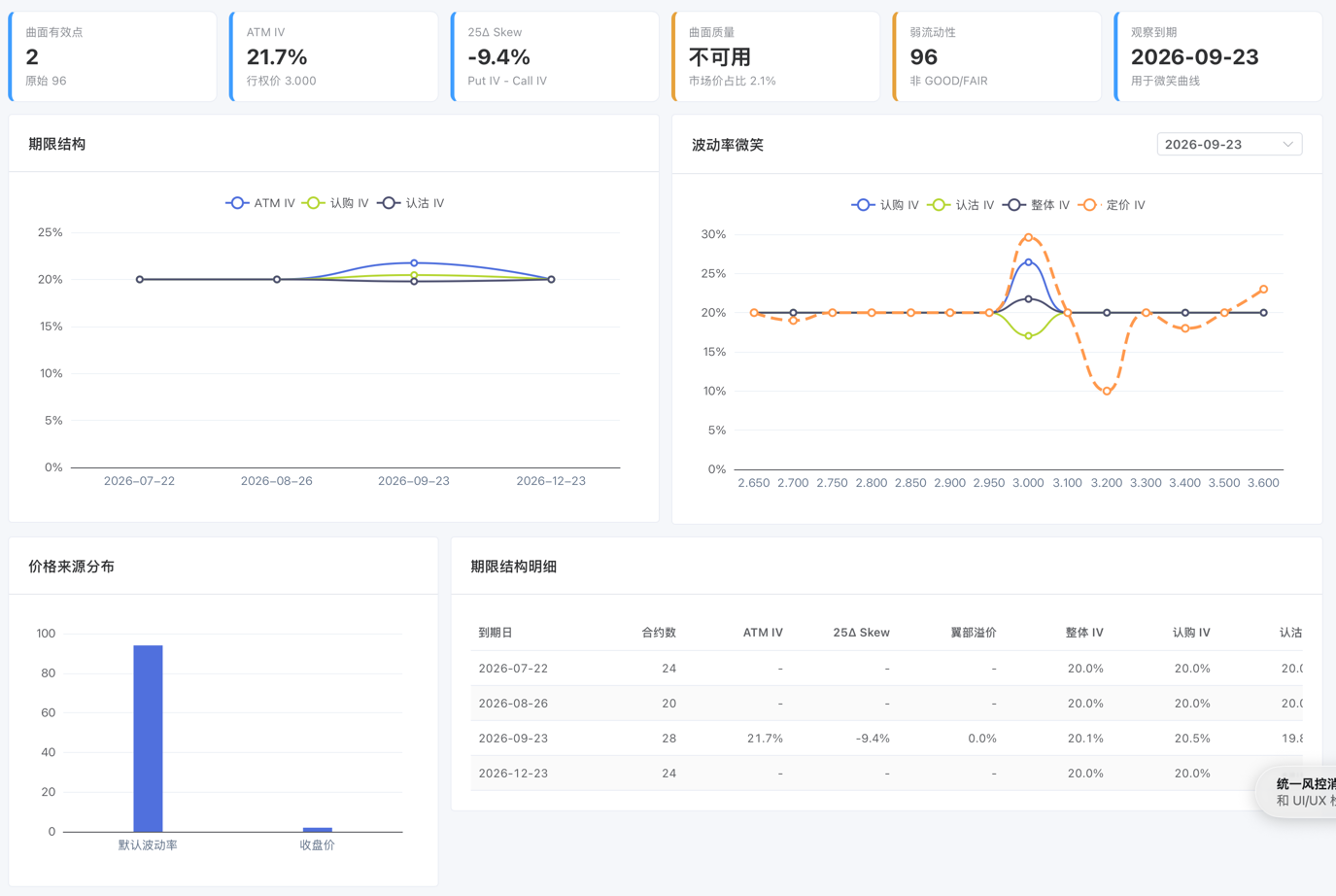
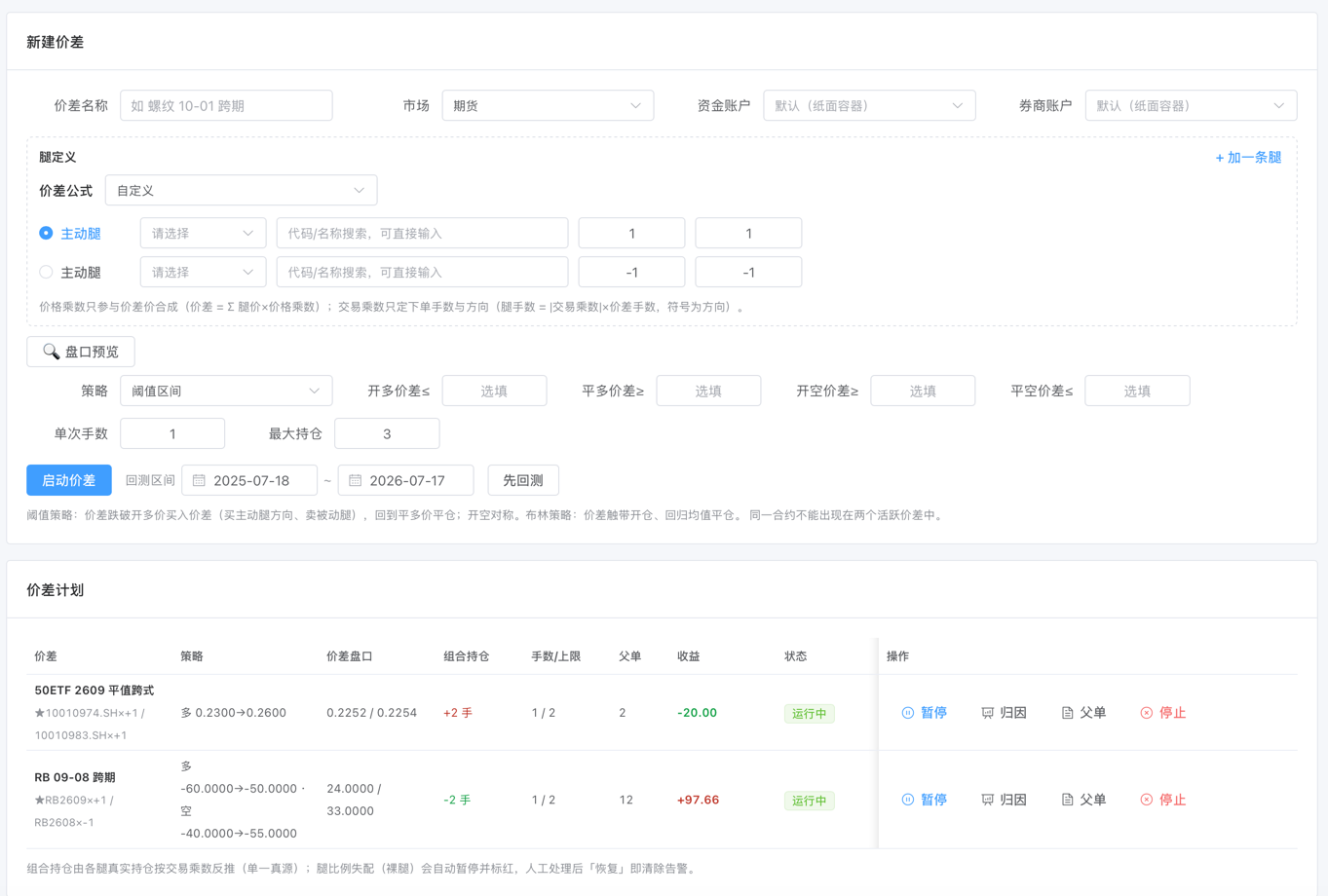
These are actual screens from the online console. Contact us for a demo account to explore them yourself.

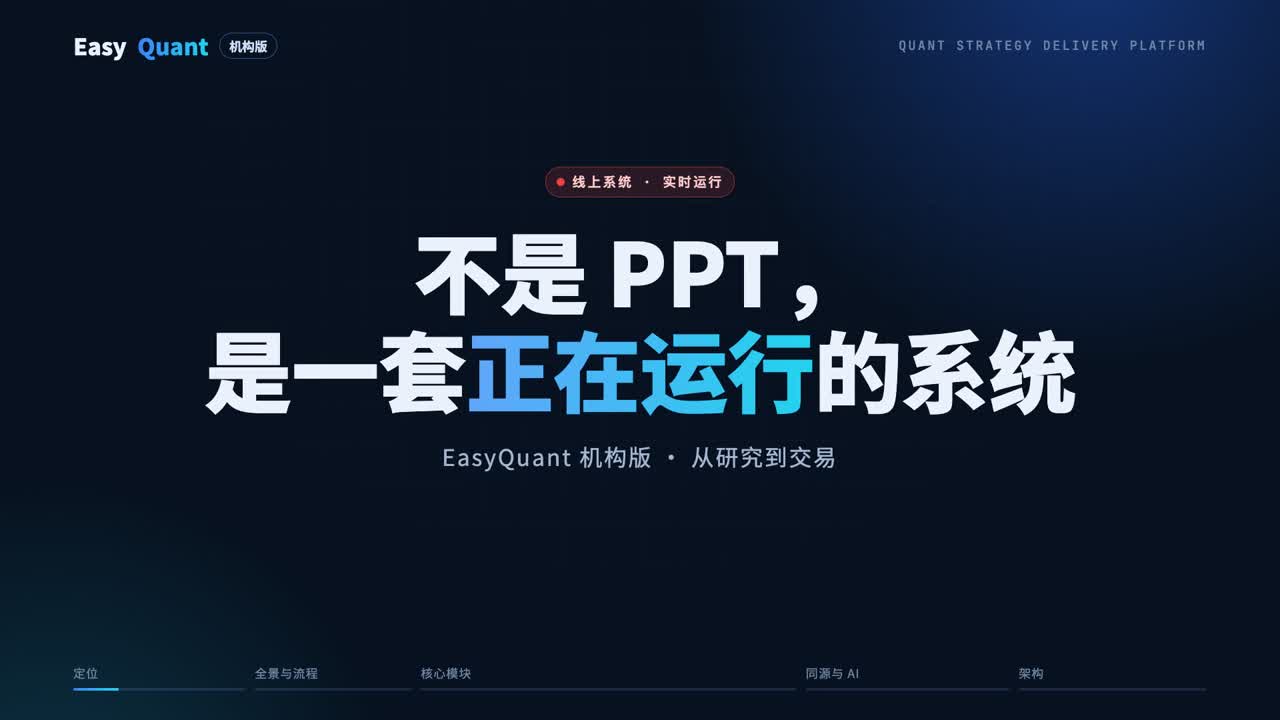
EasyQuant overview video poster ▶

About two and a half minutes covering platform positioning, architecture and actual screens from eight core modules.

Explore the online system

Our system runs continuously online with real data, so you can explore the interface beyond screenshots and illustrations.

  • Management dashboard: consolidated capital, returns and risk across accounts
  • Strategy center: instances, versions, monitoring, scores and Barra attribution
  • Backtest center: executable assumptions and reproducible input snapshots
  • Execution: manual trading, algorithmic parent orders, execution quality and order-flow compliance
  • Risk and reporting: account and product circuit breakers, rule hits and institutional reports
Request a demo account

Screens show the actual system. Account and strategy figures are paper trading results for feature demonstration, not investment advice.

AI × Quant

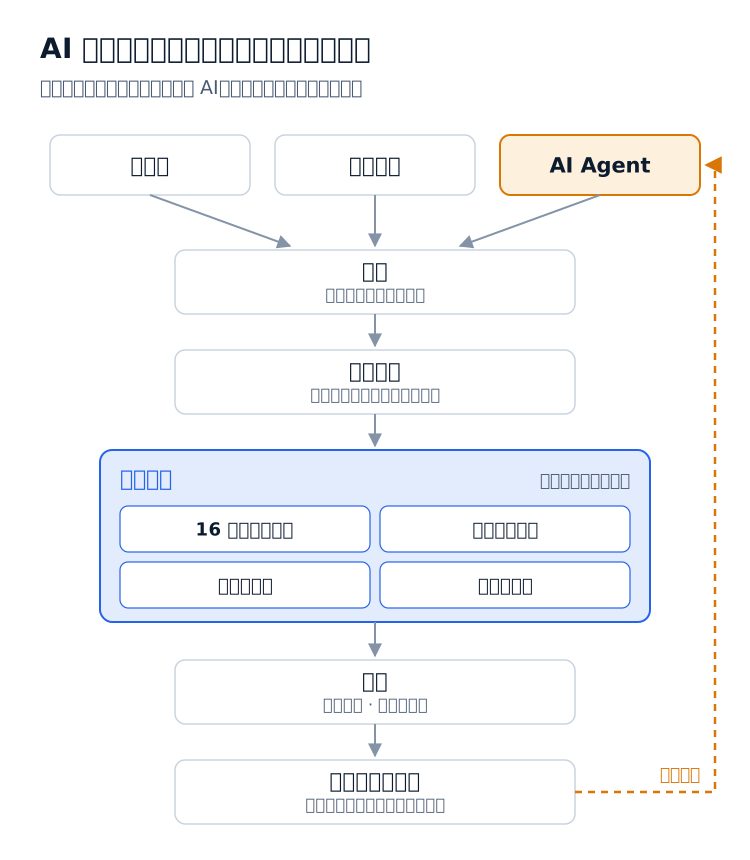
AI proposes. The system validates and governs.

LLMs help read text, propose hypotheses, write code and explain signals. Capital management, liquidity, slippage, risk and accounting require deterministic, reproducible and auditable processes.

  • AI-proposed strategies enter the same backtest engine, using executable assumptions.
  • Start with forward paper trading to test beyond history the model may have memorized.
  • Before orders, apply the same risk checks and circuit breakers as manually designed strategies, regardless of their source.
  • Results return to Performance and attribution to distinguish market and style effects from strategy skill.

For external agents, the platform provides standard backtesting, paper trading, risk and execution capabilities: agents can change and models can improve while the foundation remains consistent.

AI research, AlphaSpec and strategy integration →
Researchers, rule strategies and AI agents share the path through backtesting, paper trading, risk, execution, accounting and attribution
Signals from researchers, rules or AI follow the same path and pass the same gates.
Capabilities

Six core capabilities

Each capability corresponds to an existing console module.

Factors and research

Factor libraries, versioning, discovery and backtesting; Barra styles and IC decay and correlation for China A-share factors.

Factor library IC / ICIR Barra attribution
Strategy production

Strategy factory for research and strategy center for production: projects, drafts, optimization, releases, instances, active versions and release gates.

Strategy DSL Version governance Release gates
Backtesting and validation

Equity portfolio, derivatives portfolio and single-instrument engines, with batch backtests, parameter diagnostics and input provenance.

Three backtest engines Parameter diagnostics Provenance
Trading and execution

TWAP, VWAP, POV and iceberg parent orders, manual trading, execution quality metrics and order-flow compliance counters.

Algorithmic execution Execution quality Compliance counters
Risk and governance

Unified pre-trade checks, risk budget reservations, strategy and portfolio circuit breakers, reconciliation workflows and tenant audits.

Pluggable rules Two-level circuit breakers Reconciliation workflows
Derivatives

Option chains, volatility surfaces, portfolio Greeks and stress tests; futures dominant-contract mapping, expiry liquidation, automatic rolls and end-of-day settlement.

Greeks Contract rolls and liquidation Spreads and hedging

Markets covered

China A-shares ETF Futures Options Convertible bonds US equities Crypto

Supported broker gateways

CTPOPENCTPQMTXTPTORAEMTPTRADEIBKR
Listed as supported integrations, not partnerships. Connect your existing channels without being tied to one broker.

Technology foundation

Java 21 · Spring BootTimescaleDBRedisDisruptorPrometheusDocker / Helm
Build-enforced dependency boundaries and architecture tests prevent regressions.

Explore it yourself

Request a demo account and private deployment plan suited to your team, strategies and risk requirements.

Book an institutional demo Read the blog (Chinese)